Skip to content

Alans Almanac

Your seasonal guide

Menu
  • Alans Almanac
  • Features and Articles
  • Contact
  • About
Menu

January seasonal events and outdoor activities

The shortest day has passed, welcome to the longest month. Find out what to do and see with this guide to January seasonal events and outdoor activities.

Nature has undoubtedly mastered the art of winter gardening and even the most experienced gardener can learn from the unrestrained beauty around them.

Vincent A. Simeone
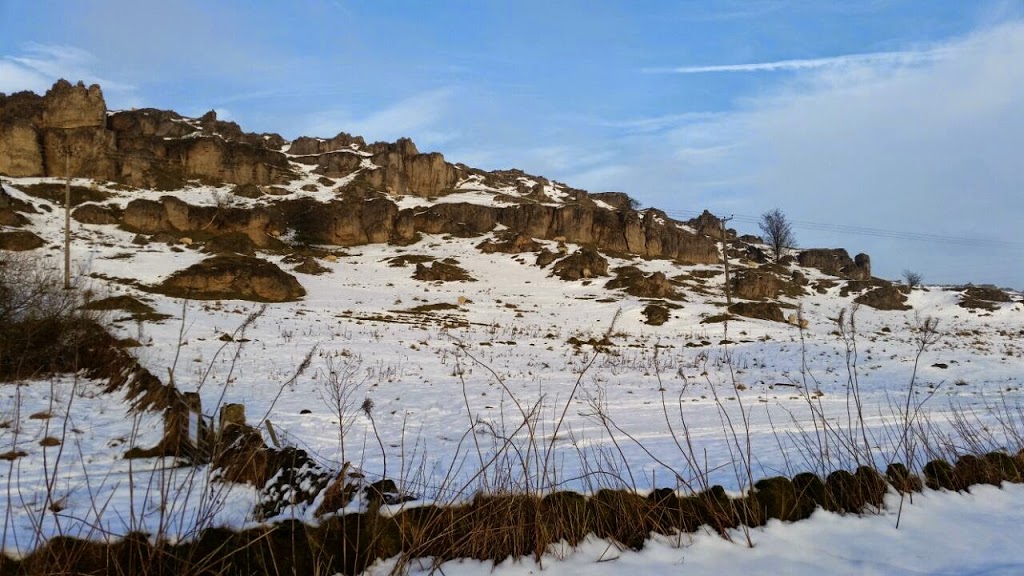
Wide-angle view of Harboro Rocks in Derbyshire, showcasing the dramatic limestone formations that rise sharply from the grassy landscape. The jagged rock faces are weathered and cracked, reflecting centuries of erosion, with crevices and natural patterns etched into the stone. Sparse tufts of grass and low-growing vegetation cling to the base and crevices of the rocks, adding splashes of green to the otherwise grey-and-beige landscape. The sky above is expansive, with a vibrant blue hue and minimal clouds, emphasizing the open, rugged beauty of the Peak District. In the distance, rolling hills can be faintly seen, blending into the horizon, completing the scenic and tranquil atmosphere of this natural landmark.
View of Harboro Rocks, Derbyshire.

Jump to....

Toggle
  • January Almanac
  • Dates, events, holidays and festivals.
  • January seasonal foods
  • In nature
  • On the farm in January
  • Things to do in January
  • Frosty days and nights
  • Recipe of the month.
  • January in the vegetable garden or allotment
  • Activities, things to see and do in January
  • Sign up for a newsletter.
  • January in pictures

January Almanac

January can seem to be the longest of months. The joy of Christmas is past, and it starts with the hangover of the New Year. Expectations are high from resolutions made, and plans for the year ahead can include fitness, wealth, and happiness. Yet it is still dark, and often wet, and frequently cold. January can be the real start of Winter, with Icy blasts from the East or North. Energy levels are low, and because of this, it is no time to make plans.

As the month progresses, there are signs of life. By the end of the month, the days are getting longer and even if it is icy cold, the first signs of spring start to show.

Dates, events, holidays and festivals.

January 2026

Public holidays

1st January – New Year’s Day

Seasonal, astronomical and nautical events

1st January – New Year’s Day

3rd January – Full Moon, Wolf Moon

10th January – Last Quarter Moon

18th January – New Moon

26th January – First Quarter Moon

Festivals and events, religious, traditional and sporting

5th January – 12th Night, Twelfth cake to be eaten

6th January – Epiphany

10th & 11th January – Wassailing at Lyveden

6th January – 12th Day and Wassail Day

24th January – Winterfest Clevedon

25th January – Burns Night

26th January – Manchester Food And Drink Festival (MFDF)

27th January – Holocaust Memorial Day

Find more events and notable dates throughout the year


January seasonal foods

What foods are seasonal in January?

Greens and leaves: Brussels sprouts, winter cabbage, savoy cabbage, Cauliflower, Chicory, Purple sprouting broccoli, Pak choi, Radicchio, Kale.

Roots and other vegetables: Beetroot, Celery, Celeriac, Jerusalem artichoke, Leek, Onion, Spring onion, Parsnip, Sweet potato, Maincrop potato, Swede, and Turnip.

Meat: Beef, Chicken, Goose, Pork, Venison,

Fruit: Chestnut, Bramley apple, Pears.

Seafood: Cod, Crab, Mussels, Oyster.

Exotics: Banana, Clementine, Date, Grapefruit, Lemon, Orange, Pomegranate.

Find out more about seasonal foods throughout the year with a guide to Seasonal foods.


In nature

Snow, frost, mice, owls, mud, darkness. This can be the coldest time of year with the greatest chance of Snow in many places.

A good time to plant trees and hedges if the ground is not flooded or frozen.


On the farm in January

It is a time for general farm maintenance such as hedging, tree planting, ditch and drainage clearance and fencing. Other ongoing repairs.

Sheep are in lower pastures and being given additional feed such as hay, beets, Wurzells and Sheep nuts.

Calves are weaned at end of the month and fed on concentrates and sugar beet. Cows loafing close to or within Barns helps protect the pasture from compaction and trampling, and there is little or no plant growth.

It is a time for manure and slurry spreading, especially hay and silage fields.

Find out more about what is happening in the Year on the farm
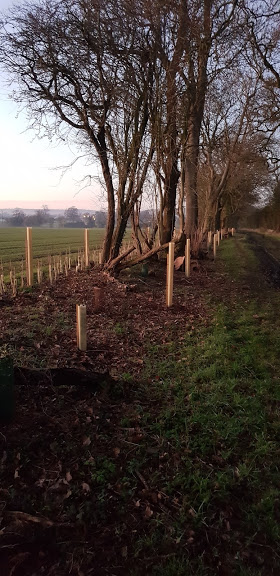

Detailed view of a newly planted hedge along an existing tree line in a rural setting. The hedge consists of young, slender saplings, freshly planted in neat rows, with the soil around them disturbed, indicating recent work. The saplings are supported by wooden stakes and spaced evenly, showing careful planning and adherence to traditional countryside hedging techniques. Behind the new hedge, mature trees form an established tree line, their bare branches reaching up to the grey, cloudy sky. The larger trees provide a backdrop of natural woodland, blending with the rural landscape. The ground is a mix of grass and soil, slightly uneven, and the entire scene conveys a sense of environmental stewardship and landscape restoration. The muted tones of the overcast sky and winter vegetation emphasize the early stages of the hedge's growth within the broader natural setting.
View of a newly planted hedge and older trees

Things to do in January

Also, see the Out and About blogs

Frosty days and nights

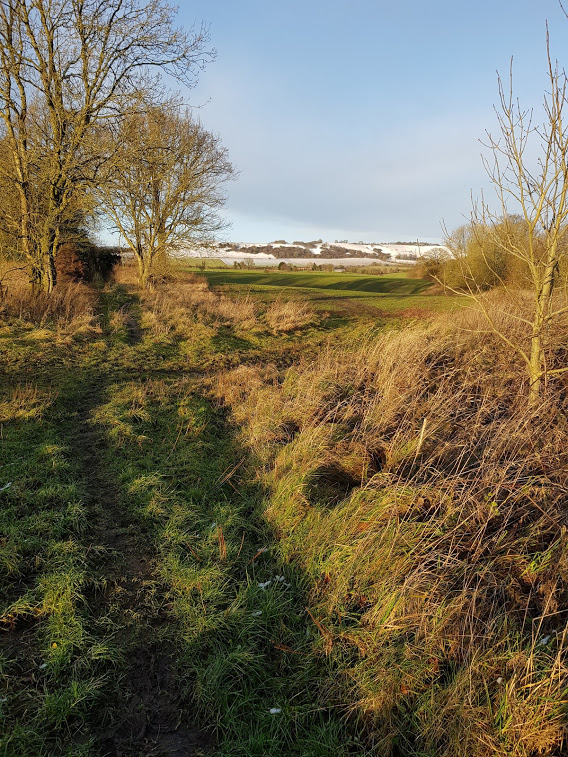
Winter landscape in the North Wessex Downs, featuring a frosty field under a pale, overcast sky. The ground is dusted with frost, giving a shimmering, silver appearance to the grass and low-lying vegetation. Bare trees stand in the distance, their branches stark against the grey sky, while a narrow dirt path winds through the scene, partially frozen and flanked by a hedge. The muted tones of the landscape, with hints of brown and white, create a serene, almost melancholic winter atmosphere typical of January in this rural part of England.
North Wessex Downs, with snow in the distance

Recipe of the month.

Cheese and Potato Pie

Rustic potato and cheese pie with a golden, crispy topping, served in a cast-iron dish on a wooden table with a spoon lifting a portion.
Rustic Cheese and Potato Pie

A traditional British dish that has a place at the modern table. The Irish variant is called Champ. Delicious, comforting, warming: ideal for a cold, damp day. Let’s get into the recipe, as I hate scrolling for it – I will add the extra information at the end.

Ingredients

1kg / 2lb Potatoes, peeled and cut into large chunks. King Edward, Maris Piper, Desiree, Golden Wonder, Rooster work best.

25g / 1oz butter, diced, plus extra for greasing

250ml / 9fl oz milk

1 teaspoon English mustard powder or English mustard

250g / 9oz mature Cheddar, grated

5–6 spring onions, finely sliced

1 large free-range egg, beaten

Salt and freshly ground black pepper

Equipment.

  • Largish pan
  • Spud masher
  • Deep baking dish

Preparation

Peel the potatoes, chop them into roughly equal sizes

Beat the egg in a cup

Cooking

Boil the potatoes. Place them in a large pan, add salt to taste if desired, cover partly with water and place the lid. Cook for 15 or so minutes until tender. Once cooked, drain the potatoes well, and leave to dry: either leave in colander or sieve, or place back in a warm pan on low heat for a few minutes.

Heat the oven to 190C/170C Fan/Gas 5. Grease the baking dish with butter.

Mash the potatoes thoroughly. Add the milk, butter and mustard and stir well.

Add tho thirds of the cheese, the egg mix, the chopped Spring Onions and mix again. Season to taste.

Spoon into baking dish: Smooth the top, add a pattern or leave rustic peaks according to desired effect. Sprinkle the remaining cheese over.

Bake for 40 – 50 minutes until golden brown.

Serving suggestion

This dish can be a stand-alone as a main, served with some additional vegetables like carrots and greens, or a good dollop of baked beans for extra comfort.

It can also be a great side dish for a roast or some sausages, served with seasonal vegetables, or alongside a quiche with some salad.

Variations

You can modify this dish, and you do not really need to include the egg. I have also used cream cheese instead of milk for extra richness. Add cabbage, Kale or Chard to make it Colcannon.

Bowl of sausages with gravy served on mashed potatoes and seasonal vegetables, with a mug of tea on a pub table.
Sausages with seasonal veg and Cheesy Mash Pie

It can also be a deconstructed fish pie – just use your imagination.

I often use Sunday Lunch leftovers, having purposefully over-catered the mash. Addition of carrots and sprouts essentially renders it a bubble and squeak pie – leave out the cheese, and serve with sausages, peas and gravy.

Making the best of seasonal, old knowledge of thrift

Allotment holders and Small holders will know, maybe more in February and March, what it’s like to have potatoes rapidly declining in quality, onions doing the same and both deciding it’s time to grow. As the hungry gap loomed, innovative ways of using the remaining veg were essential. Adding milk and cheese converts these basic vegetables into a tasty meal while adding valuable protein to the dish.

In more modern times, it is useful for using the Christmas remains – not just the veg, but the bizarre range of bits of leftover cheese gradually drying out in the back of the fridge.

For more inspiration see the Food Blogs


January in the vegetable garden or allotment

General Jobs

Clean pots and seed trays.

Continue digging the ground and spreading compost and manure.

Prune fruit bushes and trees. Shred and compost healthy prunings, burn or place in the green bin diseased prunings.

Repair fencing, and check wires and ties.

Continue to force chicory, protect cauliflower and parsley, and start forcing rhubarb.

Sowing and Planting

Indoors: sow – Broad beans, Cauliflower, Leeks, Onions, Peas, Radish, Salad leaves, Spinach. Sow salads and radishes. Most will need some heat to get them going, and protection from frost.

Outdoors: Plant trees and bare-root shrubs and fruits.

Plant rhubarb and split overgrown rhubarb and replant.

Plant Garlic if the ground is not frozen. Similar broad beans else set beans in pots undercover.

Harvest

Brussels sprouts, Cabbages, Cauliflowers, Celeriac, Chicory, Endive, Jerusalem artichokes, Kale, Leeks, Parsnips, Sprouting broccoli, Swede, and Winter radishes.

Find out more about what is happening in the allotment or vegetable garden
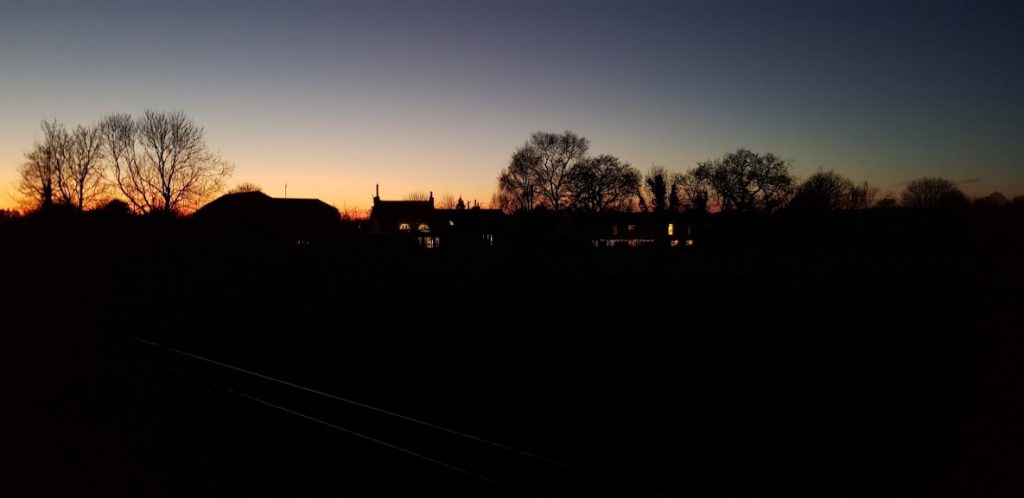
Winter evening scene in the countryside, featuring a snow-dusted field stretching towards the horizon under a glowing sunset. The sky is a blend of orange, pink, and purple hues as the sun sets, casting a soft, warm light over the cold landscape. In the distance, leafless trees stand silhouetted against the colorful sky, while the foreground reveals patches of snow covering the ground and sparse vegetation. The atmosphere is calm and peaceful, with the fading light adding a serene, almost magical quality to the winter landscape.
Winter evening scene

Activities, things to see and do in January

With short days and seemingly endless nights, January can feel like an eternity of nothingness. However, it is possible to get outside and see things and be refreshed. By the end of the month, there are the first signs of spring. If we are lucky we can have beautiful crisp, dry days and crystal clear nights. Time to wrap up and get out – even in the dark!

If it is frosty around the 17th of January, when there is a full moon, get outside. The light of a full moon on the frosty ground is quite beautiful. Let your eyes adjust, no need for a torch (except for safety near roads or dealing with obstacles). If you are lucky you may see owls flying, or badgers out and about. Look up – the universe is looking down on you.

Thinking about getting out and about, then perhaps Buy OS Landranger maps direct from Ordnance Survey to discover new places or see the latest handheld GPS devices with bundled mapping from Ordnance Survey.

Also, see the Out and About blogs


Sign up for a newsletter.

Join the Club

January in pictures

Expansive view of the Wansdyke on the Pewsey Downs, set under a bright blue sky with minimal clouds. The scene showcases a broad, undulating landscape of rolling chalk downs, covered in a patchwork of green grass and wild vegetation. In the foreground, the slopes gently rise and fall, leading the eye towards the distant ridgeline where the ancient earthwork of the Wansdyke is faintly visible. The Wansdyke, an early medieval defensive ditch and bank, blends into the landscape but stands out as a subtle elevation in the terrain. Sparse trees and shrubs dot the open fields, their shapes softened by the vast, uninterrupted sky above. The sunlight bathes the entire scene in a warm, golden hue, emphasizing the natural beauty and historical significance of this part of the North Wessex Downs. In the distance, the horizon stretches endlessly, enhancing the sense of openness and tranquility typical of this ancient chalkland.
Pewsey Downs
Scenic view of Clevedon’s seafront, with its iconic Victorian pier extending out into the calm waters of the Bristol Channel. The foreground features a rocky shoreline with large, uneven stones and patches of green seaweed, leading to the water's edge. The pier’s elegant structure, with its slender iron legs and arched supports, stretches gracefully into the distance, ending at a pavilion that sits over the water. The sky is overcast, with soft grey clouds filtering the light, giving the scene a muted and tranquil atmosphere. Along the promenade, traditional seaside houses and buildings can be seen, adding to the historic charm of the town. In the background, the distant Welsh coastline is faintly visible across the water. The scene captures both the natural beauty and the Victorian heritage of Clevedon, blending seaside tranquility with a sense of timelessness.
View of Clevedon’s Victorian pier
Winter view of the Kennet and Avon Canal near Pewsey, with a layer of frost covering the landscape. The canal winds gently through the scene, its surface partially frozen, reflecting the pale, cloudy sky. The banks of the canal are dusted with frost, and the surrounding fields and hedgerows are coated in white, creating a serene and quiet atmosphere. Bare, leafless trees line the canal, their branches delicately covered with frost, while patches of reeds and grasses along the water’s edge stand stiffly in the cold. A narrow towpath runs parallel to the canal, showing signs of recent foot traffic, adding to the tranquil, rural setting. The scene conveys the stillness of a cold winter morning, with soft light filtering through the clouds and a muted color palette of whites, greys, and browns that enhances the sense of calm and isolation. In the distance, gentle hills rise, fading into the mist, adding depth and a sense of timelessness to this frosty landscape
Kennet and Avon Canal, Pewsey
Expansive view from the Wansdyke, looking towards Knapp Hill and Adam's Grave, with the Vale of Pewsey and Salisbury Plain visible in the distance. The foreground features rolling, open farmland with fields sectioned off by hedgerows and fences, creating a patchwork of green and brown tones typical of the winter season. The earthworks of the Wansdyke stretch across the landscape, gently rising and falling with the contours of the land. Knapp Hill and the ancient burial mound of Adam's Grave are prominent features on the horizon, their shapes softened by distance but clearly visible against the backdrop of the vast Salisbury Plain.

The sky is overcast with a blanket of light grey clouds, casting a soft, diffused light over the scene. The muted colors of the landscape reflect the winter atmosphere, with patches of frost clinging to the grass and fields. In the distance, the expansive Salisbury Plain extends beyond the Vale of Pewsey, adding to the sense of scale and openness. The contrast between the historical significance of the Wansdyke and the ancient burial sites with the agricultural landscape creates a rich tapestry of natural beauty, history, and rural life, all framed by the sweeping horizon and soft, wintry light.
View towward Vale of Pewsey
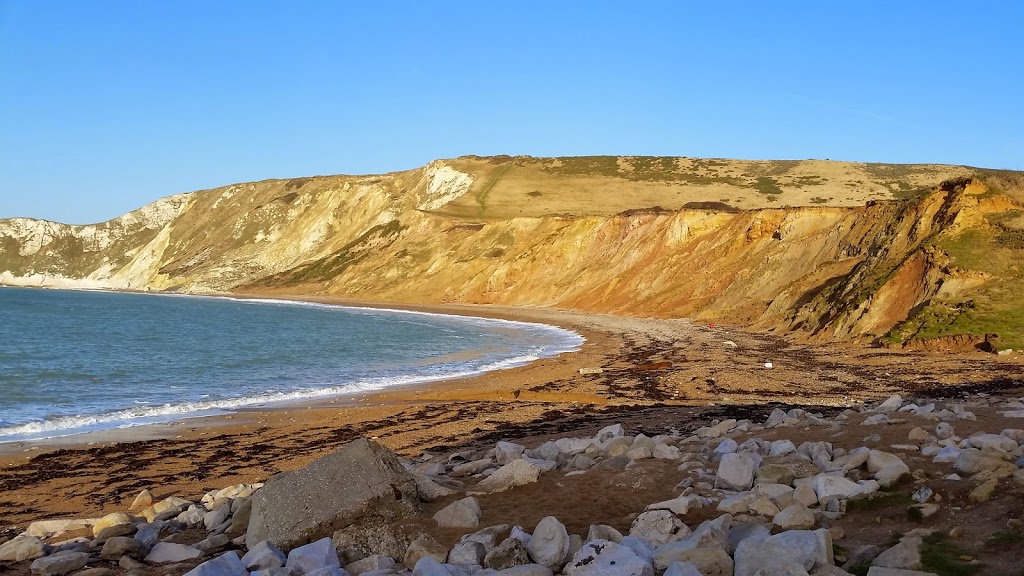
Expansive view of Worbarrow Bay, captured from the elevated vantage point of Worbarrow. The scene showcases the dramatic coastal landscape of the Jurassic Coast, with steep, rugged cliffs plunging into the sea. The cliffs, made of white and grey limestone, are weathered and craggy, revealing layers of geological history. The bay itself forms a sweeping arc of clear, blue water, gently lapping against a shingle beach that stretches along the shoreline. The water near the shore is a lighter turquoise, gradually darkening as it reaches further out to sea.

In the foreground, grassy slopes dotted with patches of wild vegetation slope down towards the cliffs, contrasting with the stark, rocky outcrops. Further out, the cliffs extend in both directions, framing the bay and curving along the coastline. The sky above is mostly clear with a few wispy clouds, allowing sunlight to bathe the scene in a warm, golden glow, enhancing the natural beauty of the area. The horizon stretches far into the distance, where the sea meets the sky, creating a sense of vastness and tranquility.

This view captures the rugged charm of the Dorset coastline, blending the dramatic geology of the cliffs with the serene beauty of the bay, offering a timeless snapshot of this iconic stretch of the Jurassic Coast.
Worbarrow Bay

🤞 Get the Newsletter

We don’t spam! Read more in our privacy policy

Check your inbox or spam folder to confirm your subscription.

Months

  • January
  • February
  • March
  • April
  • May
  • June
  • July
  • August
  • September
  • October
  • November
  • December

Useful links

Roaming the Paths

Great West Way

Tide Times

Weather Forecast (Metcheck)

Shipping Forecast

NFU Online

UK Bank Holidays

Calendar of Traditional Events

Visit Britain

UK Music Festivals

National Trust

English Heritage

CADW – Welsh Heritage

Royal Society for the Protection of Birds

RHS

Ramblers

Canal and River Trust

YHA

  • The Landscape Laid Bare – How to Love the Winter Countryside
  • January recipe of the month – Super simple Seasonal Soup
  • January recipe of the month – Time for comfort food
  • All the fun of the Mop Fairs!
  • Love Harvest – September Recipe of the month
© 2026 Alans Almanac | Powered by Superbs Personal Blog theme